
What is ABDM?
The Ayushman Bharat Digital Mission (ABDM) is the Government of India's national initiative to build a unified digital health ecosystem — run by the National Health Authority (NHA), the same body behind PM-JAY. It was launched on 27th September 2021, and its core idea is simple: give every Indian a portable digital health identity, and let healthcare providers securely exchange health records with that person's consent — no matter which hospital, clinic, or lab they visit.
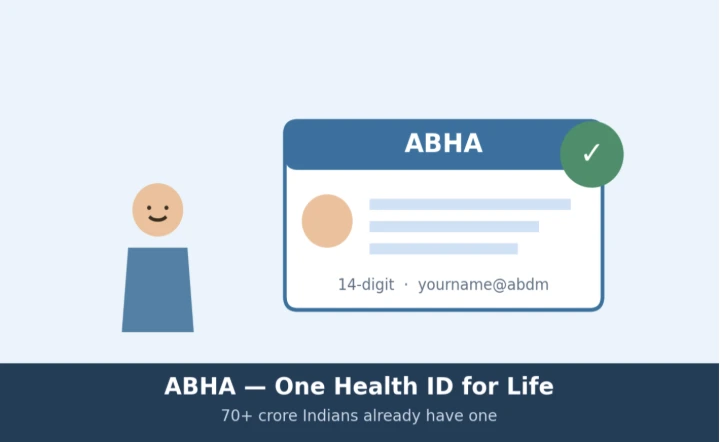
At the center of ABDM is ABHA — the Ayushman Bharat Health Account — a unique 14-digit health ID (plus a human-readable ABHA Address, like yourname@abdm) that links a person's medical records across every provider they interact with. As of the most recent figures, ABDM has crossed over 70 crore ABHA accounts nationally, alongside hundreds of millions of linked health records — making it one of the largest digital health identity systems in the world.
But ABDM isn't just “an ID card.” It's an entire ecosystem of registries, APIs, and consent infrastructure — and different stakeholders interact with it in very different ways.
ABDM in Numbers Today
A quick note on terminology first: the feature long known as “Scan and Share” has been officially renamed to Scan and Register. It's the same underlying service — a patient scans a QR code at a facility using any ABDM-enabled PHR app, approves consent, and their ABHA profile is used for instant OPD registration
— just under a new name.
According to a Press Information Bureau release dated 7th August 2026, Scan and Register has crossed a major adoption milestone:
- 25 crore (250 million) OPD registrations completed through Scan and Register since its launch in October 2022.
- Nearly 4 lakh (400,000) citizens use the service every single day.
- Operational across 30,800 healthcare facilities in 36 States/UTs and 756 districts — 24,323 public facilities and 6,481 private facilities.
- Bihar leads state-wise adoption with over 7.30 crore transactions, followed by Uttar Pradesh (4.09 crore), Andhra Pradesh (3.38 crore), and Jammu & Kashmir (1.39 crore).
- AIIMS New Delhi leads among individual facilities with over 54.29 lakh registrations, followed by AIIMS Bhopal, Bhubaneswar, Patna, and Raipur.
Dr. Sunil Kumar Barnwal, CEO of the National Health Authority, called it proof of “the growing trust that citizens and healthcare providers have placed in India's digital health ecosystem” — and a demonstration of ABDM building “an interoperable, secure and citizen-centric digital health ecosystem.”
For a hospital administrator, this scale matters practically: Scan and Register is no longer an early-adopter feature — it's operating at national scale, and patients are increasingly likely to expect it. The live ABDM Dashboard (dashboard.abdm.gov.in/abdm) and the official list of PHR apps supporting Scan and Register (abdm.gov.in/our-partners/PHR) are both publicly available for anyone wanting to check current numbers or find a compatible app.
What ABDM Means for Doctors
For an individual doctor, ABDM mainly shows up as the Healthcare Professionals Registry (HPR) — a national database of verified doctors, nurses, and healthcare workers.
- Registering on HPR verifies your qualifications and registration number against a secure, national system.
- Once registered, you get an HPR ID that lets you legitimately create and share digital prescriptions and records within the ABDM ecosystem.
- It's also a trust signal: as patients increasingly verify their doctor's credentials online, HPR registration is fast becoming the digital equivalent of a medical council registration certificate.
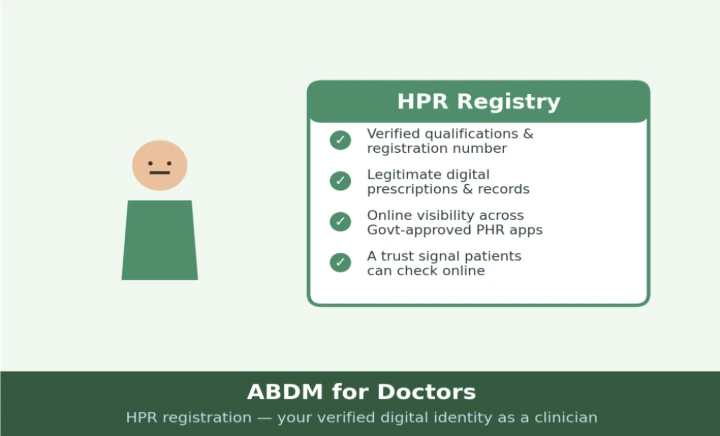
HPR is your verified digital identity as a clinician.
• Online visibility across every Government-approved PHR app — once HPR-registered, you become discoverable when patients search for doctors on the national platform, through any ABDM-empaneled PHR app. This widens your reach without any paid marketing, and can translate directly into more consultations — patients can find you, verify your credentials, and book a visit through any compatible app, not just your own clinic's system.
Practically, being HPR-registered means the digital records you create can be properly attributed, shared, and trusted across the ABDM network — not just within your own clinic's software.
What ABDM Means for Healthcare Administrators
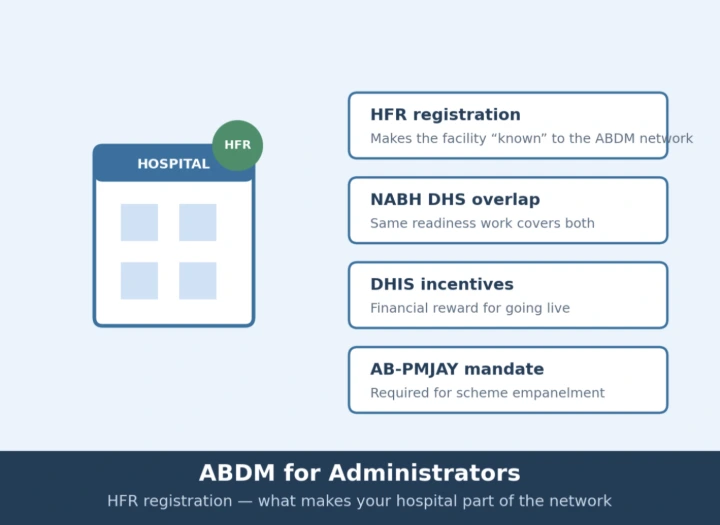
For hospital and clinic administrators, ABDM centers on the Health Facility Registry (HFR) — the national registry of hospitals, clinics, diagnostic centers, and pharmacies.
- HFR registration is what makes your facility “known” to the ABDM network — without it, your hospital's software cannot participate in ABDM's health information exchange.
- Administrators typically also drive NABH Digital Health Standards (DHS) compliance, which overlaps heavily with ABDM readiness.
- Since 2026, ABDM integration is mandatory for hospitals empaneled under AB-PMJAY and most state government health schemes, and increasingly expected even outside them.
The ROI: What This Actually Pays Back
Administrators evaluate everything on ROI, so here are the concrete numbers rather than vague promises:
- Direct government payout — under the Digital Health Incentive Scheme (DHIS), facilities with 10+ beds registered on HFR earn ₹20 per eligible ABHA-linked transaction above the monthly baseline (100 transactions/month), up to a cap of ₹4 crore per facility. As of mid-2023, close to 120 facilities — including AIIMS Delhi, AIIMS Raipur, AIIMS Bhopal, and several private hospitals — had already collected ₹4.84 crore combined under this scheme.
- Reduced duplicate testing costs — when a specialist can pull a patient's existing lab results via consent instead of re-ordering them, that's a direct reduction in wasted reagents, staff time, and equipment use per patient.
- Lower administrative overhead — QR-based Scan and Register cuts front-desk registration time and paper/printing costs at scale, which compounds across thousands of monthly OPD visits.
- Revenue protection, not just growth — AB-PMJAY and most state scheme empanelment now require ABDM integration; without it, a facility isn't just missing an upside, it risks losing an existing revenue stream.
- Faster claims cycles (via NHCX/M4) — digital, standards-based claims processing shortens the gap between treatment and insurer reimbursement, directly improving cash flow.
Put together: DHIS is real, budgeted money the facility can actually claim on its own HFR account every month — not a hypothetical benefit. For an administrator, ABDM readiness isn't a cost center to be justified on “patient experience” alone; it has a line-item payback.
For an administrator, the practical question isn't “should we integrate with ABDM” anymore — it's “how fast can we get our existing HMIS certified.”
What ABDM Means for Software Providers
This is where the real technical work happens. If you build or sell a Hospital Management Information System (HMIS), EHR, or lab/pharmacy software, ABDM compliance means your software needs to be certified against ABDM's milestone framework and pass through a formal sandbox-to-production process.
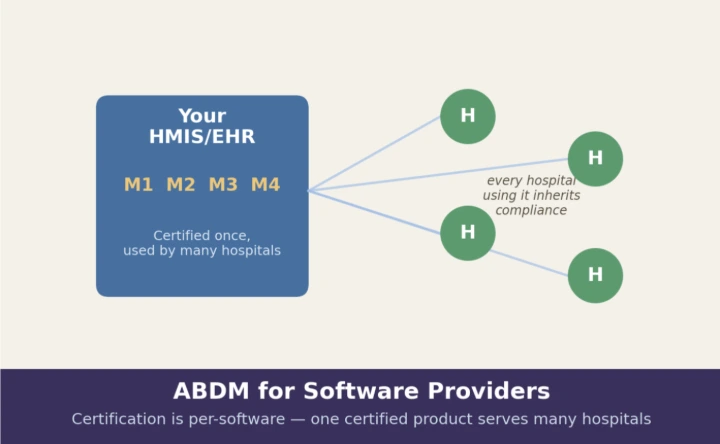
Unlike facility registration (HFR) or professional registration (HPR), ABDM certification is per-software — every distinct product needs to go through certification, even if multiple hospitals use the same product.
Part 2 of this series goes deep into how interoperability actually works and what the M1/M2/M3/M4 certification milestones and terminology standards require. Part 3 covers the certification path, accredited partners, and a full end-to-end ecosystem walkthrough.
Overall Benefits, by Stakeholder
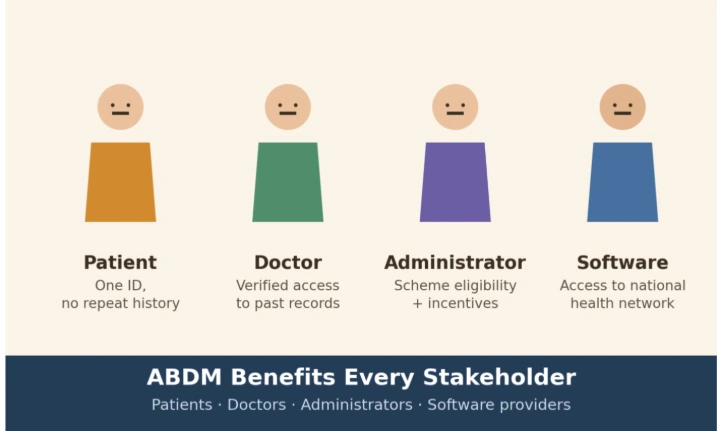
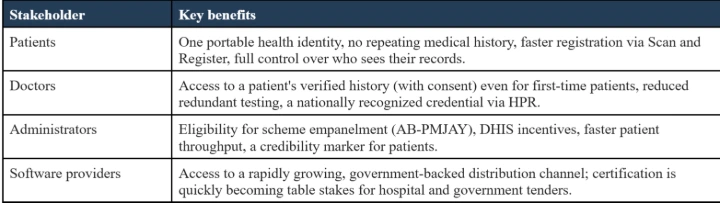
For the health system as a whole: better continuity of care, reduced duplicate testing and associated costs, faster emergency response, and a foundation for population-level health data that can inform public health policy — all while keeping data control with patients and providers rather than centralizing it.
Dr. Sri VidhyaBhavani M is a Provisionally Accredited NABH Digital Health Standards (DHS) Digital MITRA, empanelled to assess and guide healthcare facilities toward NABH Digital Health accreditation. She is the Founder & Director of Destratum Solutions Pvt Ltd, and creator of Health Attai™, an ABDM-compliant school health platform.
Sources: National Health Authority (ABDM) official documentation; PIB press release dated 7 August 2026 (“National Health Authority Achieves Milestone with 25 Crore OPD Registrations Through ABHA-based Scan and Register Service,” Release ID 2295972); publicly available ABDM integration guides current as of 2026. This is Part 1 of a three-part series — continued in Part 2: Interoperability & Standards, and Part 3: Certification, Partners & the Full Ecosystem.