
This is the final part of a three-part series on the Ayushman Bharat Digital Mission (ABDM). Part 1 covered what ABDM is and what it means for doctors, administrators, and software providers. Part 2 went under the hood into interoperability and the M1–M4 certification milestones. This part covers what it actually takes to get certified, who the accredited partners are, and walks through the complete ecosystem with a real hospital scenario.
What an Existing Software Needs to Become ABDM Compliant
If you already have a working HMIS and want to make it ABDM-compliant, the path generally looks like this:
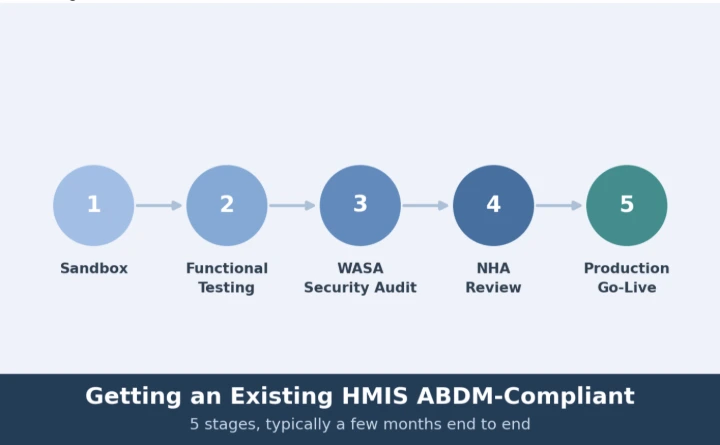
- Register on the ABDM Sandbox (sandbox.abdm.gov.in) — a free testing environment with access to all ABDM Open APIs.
- Implement the milestone APIs — ABHA creation/verification (M1), FHIR R4-based record packaging (M2), and consent-based record fetching (M3).
- Pass functional testing — an independent, NHA-recognized testing agency validates every API endpoint and workflow against ABDM's requirements.
- Complete a Web Application Security Audit (WASA) — a mandatory security certification performed by a CERT-In empaneled agency.
- NHA document submission & committee review — all test reports and audit certificates are bundled and submitted for final internal NHA review.
- Production access & go-live — once approved, the software receives production credentials and can operate in the live ABDM environment.
This process typically takes a few months end-to-end, and realistically requires dedicated technical effort — which is exactly why most hospitals choose pre-integrated HMIS platforms rather than building ABDM compliance from scratch.
Who Are the Accredited/Empaneled Partners?
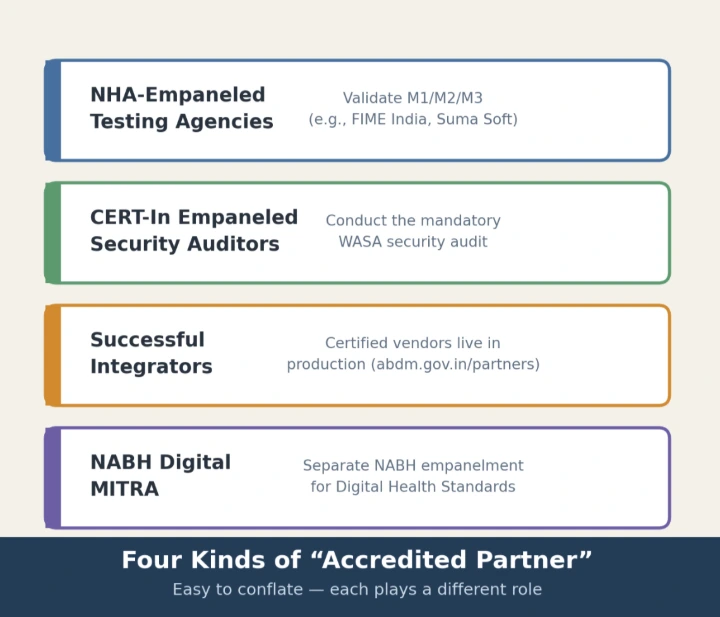
A few distinct kinds of “accredited partner” exist in the ABDM ecosystem, and it's easy to conflate them:
- NHA-empaneled functional testing agencies — independent organizations authorized to test and validate that a software's M1/M2/M3 implementation actually works correctly (e.g., FIME India Pvt. Ltd. and Suma Soft Pvt. Ltd.).
- CERT-In empaneled security auditors — agencies authorized to conduct the mandatory WASA security audit.
- Successful Integrators — software vendors/products that have completed certification and gone live in production, publicly listed at abdm.gov.in/partners.
- NABH Digital MITRA — a separate but complementary empanelment (through NABH, not ABDM directly) of individuals accredited to guide facilities toward NABH Digital Health Standards, which substantially overlaps with ABDM readiness.
If you're a hospital evaluating a software vendor, the fastest sanity check is simple: ask whether their product appears on ABDM's official Successful Integrators / Partners list
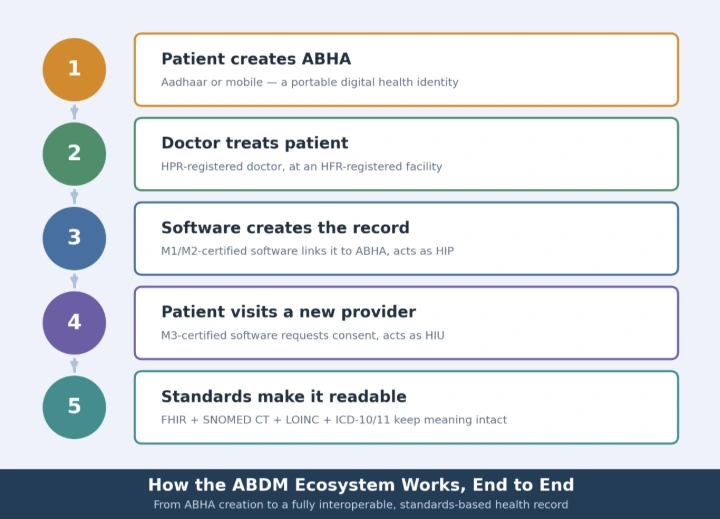
How the Ecosystem Works, End to End
A Real Scenario: Meena's Hospital Visit
Meena walks into City General Hospital's OPD for a routine check-up. At the reception desk, she's asked for her Aadhaar number or mobile number. Within seconds, the system creates her ABHA ID — a 14-digit health identity that will now follow her to every hospital she ever visits again.
Dr. Rao examines Meena. He's registered on HPR (Healthcare Professional Registry) — meaning his MBBS degree and medical council registration number have been verified by the government, so his digital prescription carries real authority, not just a signature. City General Hospital itself is registered on HFR (Health Facility Registry) — meaning the hospital is officially “known” to the national network, not just running some generic software in isolation.
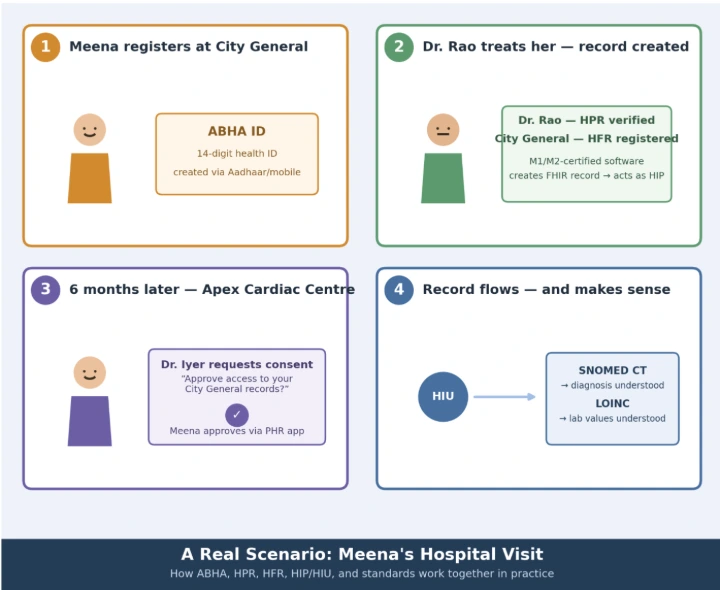
City General's HMIS software is M1/M2-certified — it created Meena's ABHA at registration (M1), and now packages Dr. Rao's prescription and the lab report into a standardized FHIR document, linked to her ABHA. In ABDM's language, City General's software is now acting as a HIP — a Health Information Provider. That record doesn't get emailed anywhere; it just sits securely, ready to be shared if and when Meena consents.
Six months later, Meena develops a complication and visits a cardiologist at a different hospital across town. That hospital's software is M3-certified, so it can act as a HIU — a Health Information User. It sends a consent request to Meena's phone via her PHR app: “Dr. Iyer at Apex Cardiac Centre is requesting access to your records from City General Hospital. Approve?” Meena taps yes. Within seconds, Dr. Iyer sees her original prescription and lab report — without her carrying a single printed page.
It's not enough that the record arrived — it has to be understood. Meena's diagnosis was coded in SNOMED CT, her lab values in LOINC, so Dr. Iyer's completely different software (from a different vendor, built by a different team) reads “Type 2 Diabetes Mellitus” and a specific HbA1c value exactly the way City General's system meant them — not as a garbled text string.
At no point did Meena's data sit in one big central government database. It stayed at City General, tagged to her ABHA, and only moved when she personally approved it. That's the whole design philosophy in one patient's afternoon.
The Same Journey, as a Technical Checklist
- A patient creates an ABHA (via Aadhaar or mobile), giving them a portable digital health identity.
- A doctor, registered on HPR, treats the patient and creates records using HFR-registered facility software.
- That software — if M1/M2 certified — creates the ABHA-linked record and makes it available as a Health Information Provider (HIP)
- When the patient visits a different provider, that provider's software — if M3 certified — acts as a Health Information User (HIU), requesting consent through a Consent Manager, and retrieving the patient's history via the Gateway.
- Standards like HL7 FHIR R4, SNOMED CT, and ICD-10/11 ensure the data means the same thing regardless of which software created it or which software is reading it
No single organization “owns” the patient's data in this model — it's federated, consent-gated, and standards-based by design.
Making This Sustainable: The State Government's Role
Technology and policy alone don't sustain a digital health ecosystem — people do. A state government can make ABDM adoption durable by investing in two talent pipelines, starting before graduation rather than after:
- Final-year doctors and nurses: introduce a short Digital Health & Standards module into MBBS/nursing curricula covering ABHA, HPR, and consent-based data sharing, and fold HPR registration into internship onboarding so it becomes routine from day one.
- Engineering graduates: introduce Health Informatics electives covering HL7 FHIR and ABDM integration, and support internships or a small state innovation cell where students can build AI models on anonymized public health data.
Doing both together — not just one — is what makes the ecosystem self-sustaining: clinicians who trust and use the systems, and a local technical talent base that doesn't leave the state dependent on external vendors for every upgrade.
Dr. Sri VidhyaBhavani M is a Provisionally Accredited NABH Digital Health Standards (DHS) Digital MITRA | PhD (HMIS), IIT Madras, empanelled to assess and guide healthcare facilities toward NABH Digital Health accreditation. She is the Founder & Director of Destratum Solutions Pvt Ltd, and creator of Health Attai™, an ABDM-compliant school health platform.
Sources: National Health Authority (ABDM) official documentation and sandbox program; ABDM Sandbox test case documentation (community-maintained mirror); PIB press release dated 7 August 2026 (Release ID 2295972); publicly available ABDM integration and certification guides current as of 2026. See Part 1 for the ABDM overview, Part 2 for interoperability and standards, and Part 4 for a state-specific case study on making Tamil Nadu's CMCHIS NHCX compliant