
This is Part 4 of a five-part series on the Ayushman Bharat Digital Mission (ABDM). Parts 1–3 covered ABDM's stakeholders, interoperability, and certification. This part applies that foundation to a live, state-specific case: what it would take to make Tamil Nadu's Chief Minister's Comprehensive Health Insurance Scheme (CMCHIS) compliant with the National Health Claims Exchange (NHCX) — the M4 milestone covered in Part 2. Part 5 continues with the practical implementation challenge and rollout plan.
Why This Is Timely
This isn't a hypothetical exercise. At the National Health Authority's two-day National Review Meeting (Chintan Shivir) on AB PM-JAY and ABDM, held 17–18 July 2026, Tamil Nadu specifically presented its experience in claim revenue utilisation under CMCHIS and its integration with AB PM-JAY — showing how reinvested claim revenues have strengthened public health institutions through infrastructure, equipment, human resources, and digital systems. The same meeting discussed how NHCX can facilitate faster settlement of approved AB PM-JAY claims, improving access to working capital for empanelled hospitals.
In other words: Tamil Nadu is already at the table on this. The question isn't whether CMCHIS engages with NHCX — it's how fast the technical integration catches up to the policy conversation already underway.
What Is CMCHIS, Briefly
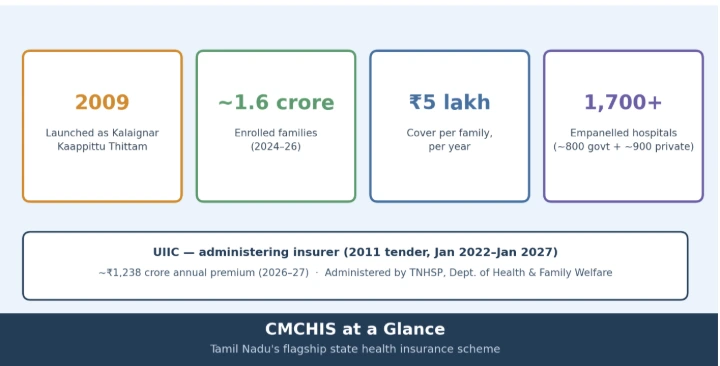
The Chief Minister's Comprehensive Health Insurance Scheme (CMCHIS) is Tamil Nadu's flagship state health insurance scheme, originally launched as Kalaignar Kaappittu Thittam in July 2009. It currently covers roughly 1.6 crore enrolled families (2024–26 range), with cover of ₹5 lakh per family per year, delivered through 1,700+ empanelled hospitals (around 800 government and 900 private) across every district. UIIC was selected as the administering insurer via competitive tender in 2011; the current implementation term runs January 2022 to January 2027, with an annual premium of roughly ₹1,238 crore paid by the Tamil Nadu Government for 2026–27. The scheme is administered by the Tamil Nadu Health Systems Project (TNHSP), Department of Health & Family Welfare, with Third-Party Administrators (TPAs) empanelled by UIIC handling pre-authorization, identity verification, and cashless claim settlement at each hospital. CMCHIS beneficiaries can now link their ABHA number for faster claim processing, as covered in Part 1 of this series.
What Is NHCX, in More Depth
The National Health Claims Exchange (NHCX) is a digital gateway — developed under ABDM by the NHA in consultation with IRDAI — that standardizes how claims-related information moves between hospitals, insurers, TPAs, and government scheme administrators. It's built on the Health Claim Exchange (HCX) Protocol: an open, interoperable, machine-readable, and auditable communication standard, aligned with IRDAI's “Insurance for All by 2047” vision.
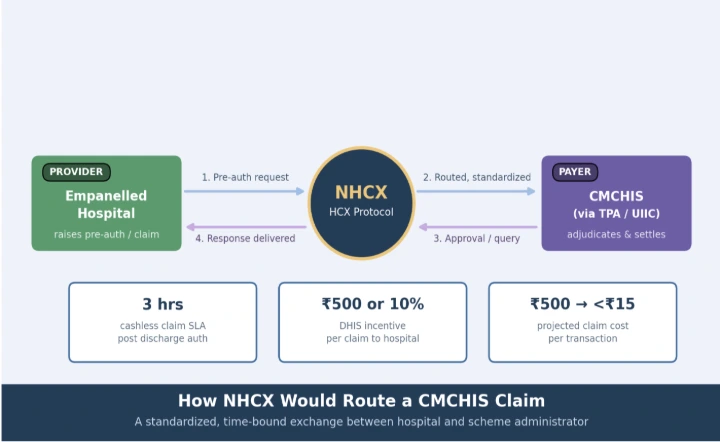
Before NHCX, a hospital dealing with CMCHIS, AB-PMJAY, and a dozen different private insurers had to work through as many different portals, each with its own format and process. NHCX replaces that fragmentation with one standardized gateway — the same core idea as HIP/HIU for clinical records, but applied specifically to the claims/insurance side of healthcare.
- As of May 2026, 160 integrators and over 12,600 hospitals were already onboarded to NHCX nationally.
- A new timeline mandates that cashless insurance claims be processed within 3 hours of receiving discharge authorization from the hospital.
- Early pilot data suggests claim processing costs could fall from roughly ₹500 to under ₹15 per transaction — a reduction with real implications for how affordably a scheme like CMCHIS can be run at 1.6 crore-family scale.
Why CMCHIS Specifically Needs This
- Hospital cash flow — empanelled hospitals treating CMCHIS patients currently wait on manual, portal-based adjudication. NHCX's 3-hour SLA for cashless claims directly shortens the gap between discharge and reimbursement, which matters most for smaller empanelled hospitals with tighter working capital.
- State-level fraud detection and analytics — standardized, coded claims data (rather than uncoded, unstructured submissions) lets the state's analytics tools actually run fraud analytics and utilisation reporting, the same kind of evidence-based planning NHA's Health Analytics and AI Unit demonstrated at the July 2026 review.
- Reinvestment of claim revenue — Tamil Nadu itself has already publicly framed CMCHIS claim revenue as a lever for strengthening public hospitals: infrastructure, equipment, human resources, and digital systems. Faster, cheaper claims processing directly increases the revenue available to reinvest, since less of it is lost to administrative overhead and processing delay.
- Beneficiary transparency — for the crores of families covered, NHCX's design goal of a transparent, traceable, time-bound claims process replaces today's opacity around preauthorization status and claim outcomes.
What NHCX Compliance Actually Requires
This follows the same shape as the M1–M3 milestones covered in Part 2, applied to the claims side (M4):
- HCX Protocol implementation — the hospital-side HMIS (and CMCHIS's own claims processing system, likely operated through or alongside UIIC) needs to implement the HCX communication protocol for pre-authorization requests, claim submission, status tracking, and payment confirmation.
- FHIR-based, coded claims data — diagnoses and procedures need to be submitted using coded terminology (the same SNOMED CT / ICD-10-11 standards covered in Part 2) rather than free-text descriptions, so NHCX can route and adjudicate them programmatically.
- Sandbox testing and certification — following the same NHA-empaneled functional testing and CERT-In WASA security audit process described in Part 3, adapted for claims workflows rather than clinical HIP/HIU workflows.
- TPA/insurer-side integration — since CMCHIS operates through UIIC as its administering insurer, UIIC's own claims systems need parallel NHCX integration — CMCHIS compliance isn't just a hospital-side project, it requires the insurer side to be ready too.
The practical starting point for Tamil Nadu's health department is the same three questions raised throughout this series: which hospitals are already HFR-registered and running certified HMIS software (Parts 1–3), whether UIIC's claims systems are NHCX sandbox-tested, and whether the state has a clear owner coordinating both sides of that integration.
Steps for the CMCHIS Portal to Become NHCX Compliant (as Payer)
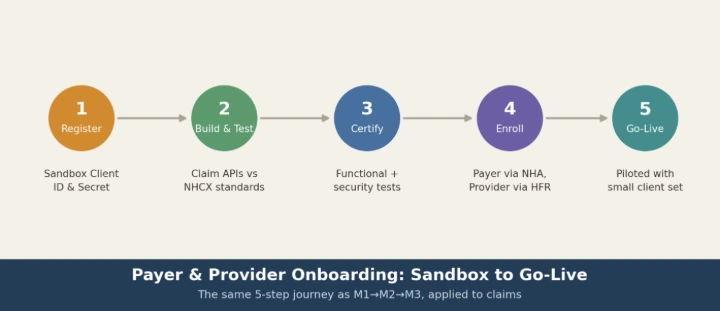
NHCX treats insurers, TPAs, and government scheme administrators as “Payer” participants — a distinct role from the hospital (“Provider”) side, with its own onboarding path. For CMCHIS, this work would typically be done by or alongside UIIC as the scheme's administering insurer. The steps below follow NHCX's own published domain specifications and NRCeS/C-DAC's “Standards for NHCX” guidance:
Phase 1 — Sandbox (identical process for Provider or Payer)
- Registration — apply at sandbox.abdm.gov.in; once verified, receive a sandbox Client ID and Secret; generate an access token and call the participant/create API to obtain a Participant Code.
- Technology development — integrate and test claim-processing APIs against NHCX standards, using the sandbox's documentation and libraries for FHIR generation, encryption, and code generation.
- Sandbox certification — pass functional testing (FHIR bundle validation, key use-case testing) and security tests, followed by an internal NHCX review and an HTC demo, to receive a completion certificate.
Phase 2 — Go-Live (enrollment differs by role)
- Payer enrollment (CMCHIS/UIIC): the insurer/TPA nodal officer enrolls entity details in the NHA/IRDAI portal (Entity Name, Registry ID, Address, Role = Payer/TPA, Bridge ID, encryption certificate). An IRDAI/NHA officer reviews and approves the application; the portal registers the participant; NHCX verifies via registry APIs; the ABDM Gateway then issues PAYER/TPA client credentials.
- Provider enrollment (empanelled hospitals): the hospital nodal officer enrolls entity details in HFR (Entity Name, HFR ID, Address, Role = PROVIDER, Bridge ID, encryption certificate); the HMIS registers the hospital in the NHCX registry; NHCX verifies via HFR registry APIs; the ABDM Gateway then issues PROVIDER client credentials and a Participant Code.
- Credential provisioning — a Client ID and Secret are issued (the same mechanism as production ABDM M1); the participant is responsible for safeguarding credentials and reporting any breaches.
- NHCX registration — existing HFR (for hospitals) or IRDAI registration (for CMCHIS/UIIC) can be reused to authenticate directly into the NHCX registry, rather than starting from scratch.
- Go-live — the application goes live after staff training and change-management planning, ideally piloted with a small client set first rather than a full-network cutover.
What's Required from Empanelled Hospitals
On the provider side, an empanelled hospital's requirements build directly on the foundations covered in Parts 1–3 of this series — NHCX compliance is largely an extension of work a hospital may have already started:
- Be HFR-registered — the hospital's facility identity on the national network, without which it cannot be recognized as a valid claims-submitting entity.
- Have HPR-registered treating doctors — so prescriptions, diagnoses, and procedures attached to a claim carry a verified clinician's digital signature.
- Run NHCX-capable HMIS software — typically the same M1/M2/M3-certified platform used for clinical HIP/HIU functions, extended with an NHCX/claims module (several ABDM-certified HMIS vendors already offer this as an add-on).
- Generate an NHCX Participant Code linked to the hospital's HFR ID — in practice, this is a short in-software process: enter the HFR ID-linked mobile number and an email for insurance purposes, verify via an SMS passcode and emailed link, and complete a second verification step to finalize encryption settings before the Participant Code is active.
- Submit claims using coded, structured data — diagnoses and procedures need to be captured using SNOMED CT/ICD-10-11 coding (Part 2) rather than free-text notes, so CMCHIS's system can auto-adjudicate rather than manually re-key the submission
- Route eligibility checks, pre-authorization, and claims to CMCHIS's published Payer Code — replacing whatever manual, portal-specific process the hospital currently uses for CMCHIS cases specifically.
- Track claim status and respond to queries through the same NHCX channel — instead of phone calls or separate portal logins, status updates and adjudicator queries arrive and get answered through the same standardized exchange.
For a hospital already partway through ABDM compliance for clinical records (M1–M3), the incremental work for NHCX is real but bounded — it's largely about extending an existing certified platform's claims module and generating one additional Participant Code, not starting from zero. Part 5 of this series continues with the hardest practical problem this creates — converting unstructured clinical documents into coded FHIR data — and a realistic rollout plan.
Dr. Sri VidhyaBhavani M is a Provisionally Accredited NABH Digital Health Standards (DHS) Digital MITRA | PhD (HMIS), IIT Madras, empanelled to assess and guide healthcare facilities toward NABH Digital Health accreditation, and holds a PhD in Healthcare Management Information Systems (HMIS) from the Department of Management Studies, IIT Madras. She is the Founder & Director of Destratum Solutions Pvt Ltd, and creator of Health Attai™, an ABDM-compliant school health platform.
Sources: National Health Authority (ABDM/NHCX) official documentation; NHA National Review Meeting (Chintan Shivir) on AB PM-JAY and ABDM, 17–18 July 2026; CMCHIS official portal (cmchistn.com); publicly available NHCX integration guides current as of 2026. This is Part 4 of a five-part series — see Parts 1–3 for the ABDM overview, interoperability/standards, and certification/ecosystem, and Part 5 for the document-conversion challenge and rollout plan.