This is the final part of a five-part series on the Ayushman Bharat Digital Mission (ABDM). Part 4 covered why and how Tamil Nadu's CMCHIS scheme can become NHCX-compliant — the onboarding steps for both the payer (CMCHIS/UIIC) and empanelled hospitals. This part tackles the hardest practical obstacle to actually doing that: converting real, messy clinical documents into the coded FHIR data NHCX requires — and what a realistic rollout looks like.
Solving the Hardest Practical Problem: Unstructured Clinical Documents
Everything in Part 4 assumes claims arrive as coded, structured FHIR data. In practice, that's the hardest part of NHCX compliance for a scheme at CMCHIS's scale. Discharge summaries, prescriptions, and case sheets from a network of 1,700+ empanelled hospitals typically arrive as scanned PDFs, images, and handwritten notes — not structured data. Documentation commonly mixes Tamil, English, and Hindi, and handwritten notes usually require manual transcription for every claim — causing delays, transcription errors, and rising operational cost at volume.
This is where an AI-assisted clinical-document-to-FHIR converter becomes a practical necessity rather than a nice-to-have: a layer that sits between “what the hospital already has on paper or PDF” and “what NHCX requires as a coded FHIR bundle.”
What Such a Solution Would Need to Do
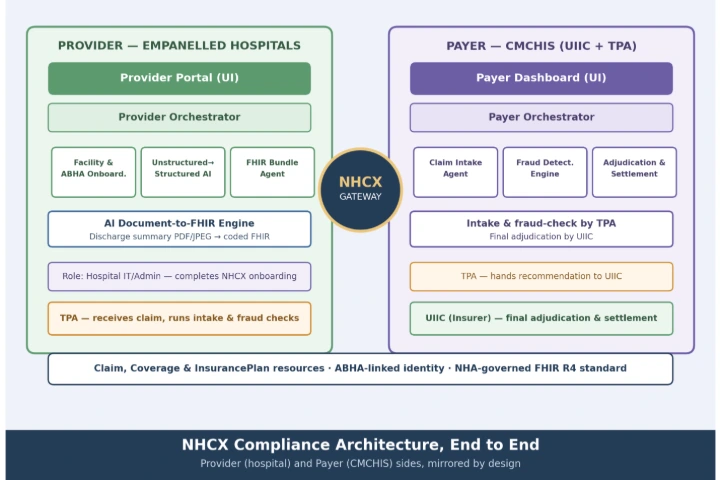
A reference architecture for this problem typically follows an agentic pipeline — an orchestrator coordinating ingestion, extraction, validation, exception-handling, and output agents — that takes a machine-readable discharge summary and produces a validated, coded FHIR bundle, with every step logged under a single job ID for auditability. On the NHCX side specifically, this mirrors the Provider/Payer split described in Part 4: a hospital-side engine converts documents into FHIR and hands them to the TPA for intake and fraud screening, while the insurer retains final adjudication and settlement authority.
- Report-type detection — auto-classifying discharge summaries versus investigation/diagnostic reports.
- Clinical data extraction — pulling patient details, diagnoses, procedures, vitals, and lab results from printed clinical text
- Terminology coding — mapping extracted clinical concepts to SNOMED CT (and LOINC for lab values) within the generated FHIR resources, exactly the standards covered in Part 2.
- FHIR bundle generation — producing ABDM-compliant Document Bundles, optionally consolidated into NHCX-style Claim Bundles.
- Validation checks — bundle structure, required-field, and profile-presence checks before data ever reaches the claims portal.
What Kind of Impact This Can Realistically Deliver
Pilot experience from similar AI-assisted document conversion efforts elsewhere in India's state health insurance ecosystem gives a useful, conservative benchmark for what's achievable on machine-readable documents specifically:

These are conservative, pilot-dependent targets specifically for machine-readable documents — end-to-end claim turnaround still depends on downstream review steps, and results for handwritten or heavily multilingual documents would need separate validation.
A Realistic Rollout Shape
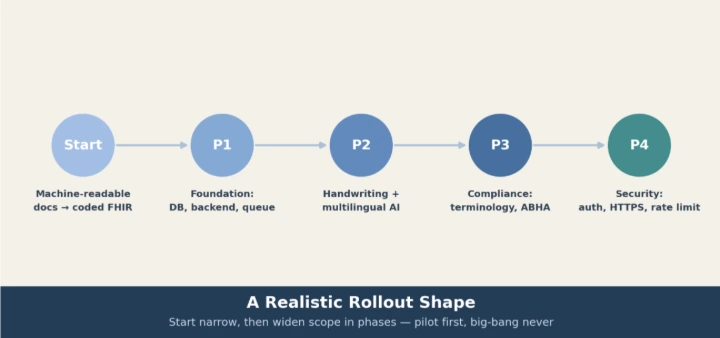
Whichever vendor or in-house team builds this, a phased approach — rather than an all-at-once rollout — tends to work better for a scheme at CMCHIS's scale:
- Start narrow — machine-readable discharge summaries and investigation reports, the highest-volume, most standardized document types, converted to coded FHIR bundles first.
- Strengthen the foundation — persistent storage, a modular backend, an async worker queue, and strict FHIR validation, before expanding scope.
- Add handwriting and multilingual support — Tamil and Hindi document handling, and case-sheet extraction, once the core pipeline is stable.
- Layer in compliance and validation — a terminology server for SNOMED CT/LOINC, and ABHA registry validation.
- Harden for production — authentication, HTTPS, rate limiting, and API versioning, before any full-network cutover.
The common thread with everything else in this series: pilot first, on real documents, with a small hospital set — rather than a single big-bang rollout across all 1,700+ empanelled hospitals at once.
Who Benefits, and How
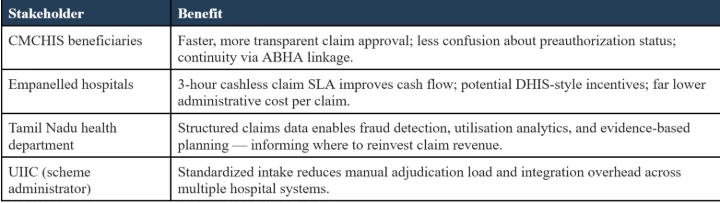
None of this requires reinventing CMCHIS. It requires connecting an already-successful, decade-old state scheme to a national claims infrastructure that Tamil Nadu is already engaging with at a policy level — closing the gap between that engagement and the technical integration on the ground.
Dr. Sri VidhyaBhavani M is a Provisionally Accredited NABH Digital Health Standards (DHS) Digital MITRA | PhD (HMIS), IIT Madras, empanelled to assess and guide healthcare facilities toward NABH Digital Health accreditation, and holds a PhD in Healthcare Management Information Systems (HMIS) from the Department of Management Studies, IIT Madras. She is the Founder & Director of Destratum Solutions Pvt Ltd, and creator of Health Attai™, an ABDM-compliant school health platform.
Sources: National Health Authority (ABDM/NHCX) official documentation; NHA National Review Meeting (Chintan Shivir) on AB PM-JAY and ABDM, 17–18 July 2026; CMCHIS official portal (cmchistn.com); publicly available NHCX integration guides current as of 2026. This is Part 5, the final part, of a five-part series — see Parts 1–3 for the ABDM overview, interoperability/standards, and certification/ecosystem, and Part 4 for the CMCHIS/NHCX compliance path.